DC charging with EVDC: faster, smarter and V2X-ready
Electric mobility is about more than "faster charging". With EVDC, the charger becomes a tool that not only puts electricity into the car, but can also take it back out. This makes bidirectional charging (V2H, V2B and V2X) truly accessible for the first time. Where conventional AC chargers are limited by the vehicle's on-board converter, EVDC delivers direct current straight to the battery.
The result: higher power, shorter charging times and the option to use your car as an energy source.
V2X: the car as part of your energy plan
With EVDC your car can charge and discharge. During expensive hours it can return energy to your home or business, and during free or cheap hours it charges up again. The vehicle becomes a flexible buffer that lowers your energy costs and increases your self-consumption.
All it takes is a few simple settings in the mySigen app: maximum discharge power, minimum battery percentage, time windows and scenarios.
How the energy flows work
EVDC automatically chooses the most logical source for DC charging:
solar energy
battery
steps in when there is not enough sun
grid power
you decide how much power may be drawn from the grid at most, how far the battery may discharge and which DC power you want to use. This way you avoid peaks, protect your installation and keep your energy costs low

Discharging (V2H/V2B) in practice
Discharging is easy to use. You set the discharge power (for example 2–3 kW) and choose the minimum SOC (State of Charge) the car must never drop below. This can happen automatically during expensive hours or peak moments.
Benefits:
- less grid consumption at expensive times
- more use of your own energy
- stability for the building
- an extra buffer without additional hardware
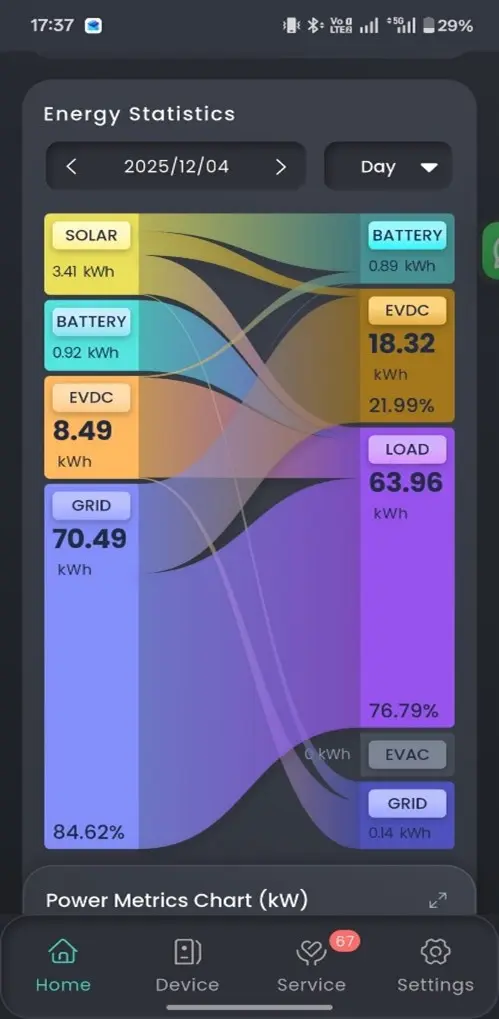
Sankey diagram: insight at a glance
The app shows a clear overview of all energy flows: from left (solar panels, battery, grid) to right (EVDC charging, building consumption, battery charging, export). When "Grid → Output" shows 0 kWh, it means no net energy went to the grid during that period.
Why EVDC is different
Its strength lies in the combination of three things:
- DC charging for fast, efficient and stable power
- smart energy choices that always use the cheapest or most sustainable source
- bidirectional charging that actively puts your car to work in your energy management
All of this is fully configurable and works together with your solar panels, home battery and existing energy management.
Installation:
EVDC is installed by a certified installer.
The DC unit is placed between the inverter and the battery, which makes installation very simple. The charging cable can be detached from the charger, so only a very small hole is needed to run the cable through the wall. The basic settings are configured on site, after which the user manages everything via the app.
What you can set yourself:
In the app you can easily set:
- DC power
- grid limit
- battery discharge limit
- charging or discharging scenarios
- energy source priorities
Tested vehicles
The DC charger is suitable for all cars with a CCS2 connector. Discharge capabilities depend on the vehicle.
Additional successful tests are regularly updated here on the website, and you can also request them from us personally.
Below you will find the full list of tested vehicles:
|
Tesla |
S Raven [2019-6] S P90D (New battery & BMS) [2015] Model 3 [2019] Model Y Performance [2024] Model Y Dual LR (NMC) [2022] Model Y SR (LFP) [2023] Model Y Cybertuck (Dual Motor) M3 |
|
Polestar |
4 [2025] |
|
Volvo |
C40 XC40 [2022] EX30 |
|
MG |
Marvel R Electric [2022] |
|
BYD |
Atto [2025] |
|
Xpeng |
G6 [2024] G9 P7i |
BMW | iX xDrive40 [2025] |
Ford | F150 Lightning Lightning Lightning Lariat [2023] EXT Range battery Mustang Mach-E Premium 1st Edition [2021] |
Mercedes | EQB 350 eSprinter |
Rivian | R1S Quad Large Adventure Package R1T |
Fisker | Ocean [2023] |
Audi | A6 E-tron [2025] Q4 [2024] |
BMW | i3S [2019] iX xDrive40 [2025] |
Hyundai | Ioniq 5 |
Citroën | eJumpy [2021] |
Skoda | Enyaq 80x [2023] |
Porsche | Taycan |
SAIC MAXUS | e Deliver 9 |
KIA | EV6 Niro EV |
Volkswagen | ID.5 |
Dodge | Charger EV Daytona Charger EV Daytona Scat Pack [2024] |
Geely | EX5 |
Genesis | GV60 |
Nissan | Ariya Leaf |
Taiga | Nomad Electric Snowmobile Snowmobile |